
What if the
darkness could
power the journey?
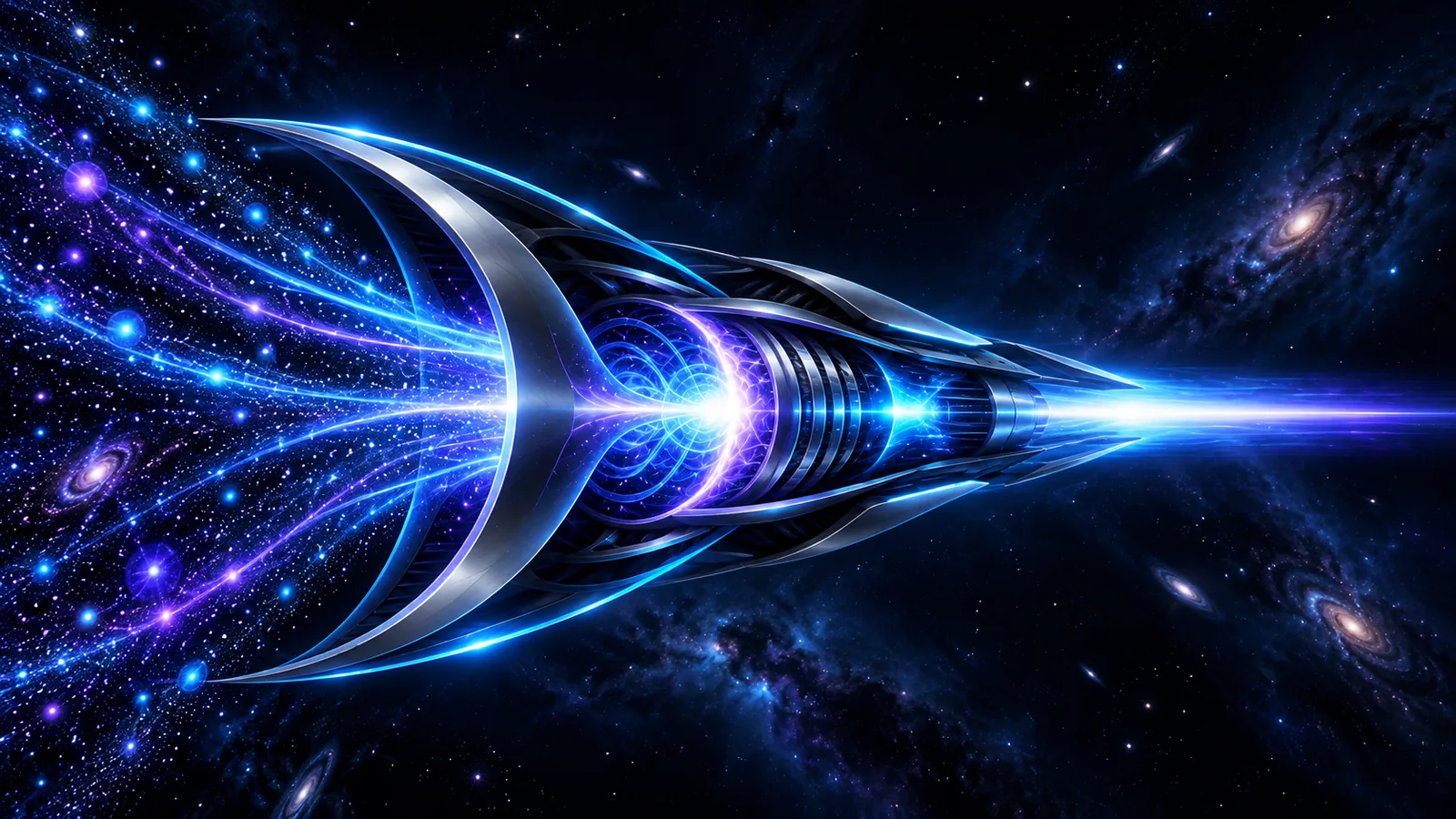
A radically different spacecraft thought experiment: harvest a hidden cosmic substrate, channel it through an engineered ramjet, and turn the unknown into directed motion.
Not a warp bubble.
A continuous flow.
Instead of bending a fictional visualization of space, explore a proposed vessel that gathers, concentrates and expels an ambient substrate.
Gather the invisible
A projected scoop field is hypothesized to guide low-energy material into a narrow intake.
Concentrate & energize
Solenoids, compression fields, a storage buffer and reactor form the imagined conversion chain.
Direct the momentum
A collimated photon exhaust completes the proposed intake-to-thrust flow.
Don't just read the theory.
Take the controls.
Orbit the vessel. Isolate individual subsystems. Change intake density, capture efficiency and exhaust energy to watch a conceptual flow respond in real time.
Open simulation ↗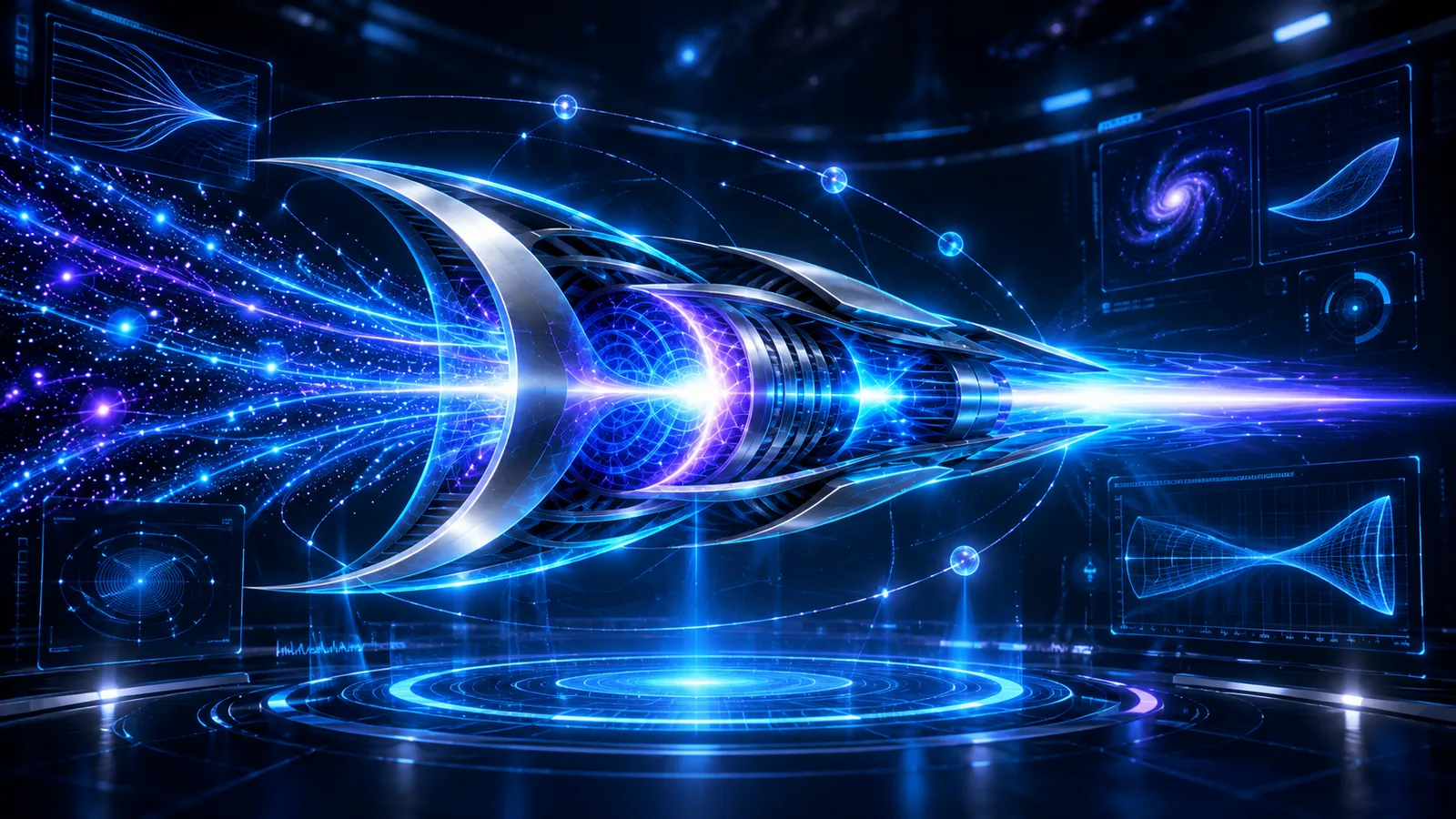
A big idea deserves
hard questions.
Explore the arguments in the project notes—alongside the observations and calculations they would need to survive.
Is the “warp bubble” really a mass-flow envelope?
Compare geometry with collection, compression and exhaust.
Explore paper →What happens when there is almost nothing to collect?
The intake-density problem of crossing cosmic voids.
Explore paper →If light slowed across the cosmos, how would we tell?
Photon-mass bounds, timing, lensing and redshift tests.
Explore paper →Curiosity, without
confusing it for proof.
Dark matter as “tired light,” kilometer-scale quantum-optical capture, and faster-than-light ramjet propulsion are speculative concepts—not established science or demonstrated engineering. The project is built to explore mechanisms and frame falsifiable questions, not to claim a working drive.
See what would need to be tested →Ready to see the flow?
Enter the interactive lab and explore the eight proposed stages.